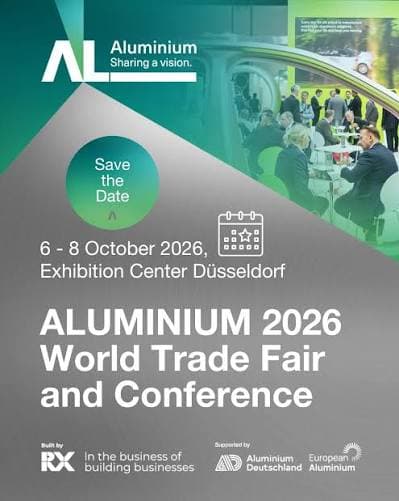
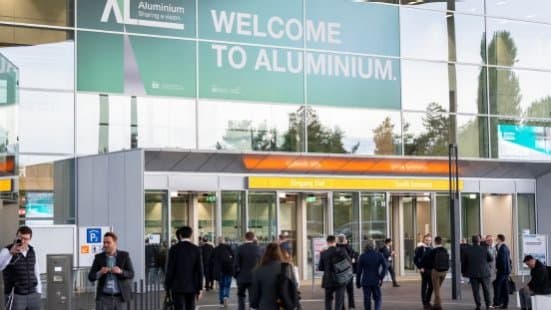
ALUMINIUM 2026 – Düsseldorf
26th – 28th September 2026
Europe’s Aluminium Sector at a Strategic Crossroads
ALUMINIUM 2026 returned to Düsseldorf as Europe’s largest and most influential gathering for the aluminium industry, bringing together producers, recyclers, OEMs, policymakers, engineers, innovators and global market analysts for two days of high-intensity discussion. With more than 800 exhibitors and thousands of visitors from over 100 countries, the event showcased the technologies, strategies, and industrial capabilities shaping the future of aluminium in Europe’s automotive, aerospace, construction, packaging and recycling sectors.
This year’s programme unfolded at a moment of profound industrial change. Electrification, geopolitical fragmentation, circularity, sustainability regulation, and Europe’s growing dependence on imported primary aluminium converged into a single strategic agenda. Across two days, speakers explored how Europe can strengthen competitiveness, secure supply, accelerate innovation, and build a resilient aluminium ecosystem capable of supporting the continent’s green and digital transitions.
Moderated across multiple sessions by Juliette Foster, the conference offered a comprehensive view of the pressures and opportunities defining Europe’s aluminium future — from lightweight engineering and EV architectures to circular sovereignty, global trade tensions, advanced recycling, packaging regulation and climate-resilient construction.
DAY 1 – INDUSTRIAL TRANSITION, COMPETITIVENESS & STRATEGIC SOVEREIGNTY
Opening Keynote – Europe’s Industrial Transition
10:15–10:30
The event opened with a keynote from Mona Neubaur, Minister for Economic Affairs, Industry, Climate Action and Energy of North Rhine-Westphalia, who set the tone for the day by highlighting aluminium’s strategic role in Europe’s industrial transition. She emphasised the need for secure supply, competitive energy prices, and coordinated policy signals to support innovation, decarbonisation and industrial resilience.
Key themes included:
- Aluminium as a strategic raw material for Europe’s green and digital transitions
- The urgency of strengthening domestic capability
- The role of policy in accelerating industrial transformation
- The need for competitive energy frameworks to support smelting and recycling
- The importance of circularity in reducing dependency and strengthening sovereignty
Innovation Aluminium – The Future of Lightweight Engineering
10:30–11:35
The opening panel explored how aluminium innovation is reshaping lightweight engineering across aerospace, defence, mobility and advanced manufacturing. Speakers examined breakthroughs in alloys, forming technologies, extrusion processes and dual-use innovation.
Key insights included:
- Lightweight engineering is now a strategic capability, not a design preference
- Advanced alloys are improving strength-to-weight ratios, corrosion resistance and fatigue performance
- Aerospace innovations could transfer more quickly into land systems and maritime platforms
- Europe’s challenge is scaling innovation from prototype to industrial production
- Certification bottlenecks and procurement silos slow cross-sector adoption
- Customers increasingly expect low-carbon aluminium solutions at industrial scale
Themes such as survivability, cost pressure, supply security and manufacturing agility underscored aluminium’s central role in Europe’s industrial competitiveness.
Automotive Under Pressure – Can Europe Keep Its Competitive Edge?
11:40–12:40
Electrification is reshaping automotive engineering, and aluminium sits at the centre of this transformation. This session examined how EV platforms, battery enclosures, gigacasting and new vehicle architectures are changing demand for aluminium.
Key themes included:
- Electrification makes vehicles heavier, increasing the need for lightweighting
- Aluminium delivers performance gains in stiffness, crash behaviour and thermal management
- Battery enclosures are becoming larger, more complex and structurally integrated
- Gigacasting is reshaping upstream manufacturing and alloy requirements
- China is scaling aluminium-intensive EV platforms at extraordinary speed
- Europe must accelerate innovation, deepen OEM-supplier partnerships and strengthen midstream capability
Speakers emphasised that Europe’s competitiveness depends on speed, precision, and the ability to industrialise advanced aluminium technologies at scale.
Recycling Equals Resilience – Securing Europe’s Sovereignty Through Circular Raw Materials
13:15–14:15
With aluminium now formally designated a critical raw material, this session explored how circularity can strengthen Europe’s sovereignty, reduce dependency and anchor value creation inside the region.
Key insights included:
- Recycling is a strategic capability, not an environmental add-on
- Europe’s vulnerability stems from system design, not resource scarcity
- Scrap leakage, mis-sorting and export weaken Europe’s resilience
- Secondary production must expand significantly to meet demand
- Affordable, low-carbon energy is essential for scaling recycling
- Circularity can reduce exposure to geopolitical shocks and supply chain volatility
Speakers stressed that circular raw materials must be treated as part of Europe’s industrial security architecture.
Global Markets, Strategic Materials – Navigating Trade Tensions, Industrial Policy & Supply Chain Risks
15:00–16:00
This session examined how geopolitical fragmentation, trade tensions, industrial subsidies and shifting alliances are reshaping global aluminium markets.
Key themes included:
- China’s overcapacity continues to distort global prices
- US industrial policy is reshaping competitive dynamics
- Europe faces structural pressures: high energy costs, limited smelting capacity, import dependence
- CBAM is a green advantage but cannot fully protect Europe from global volatility
- Europe’s aluminium model was built on assumptions of stability that no longer exist
- Industrial support may become unavoidable if Europe wants to remain competitive
Speakers highlighted the need for a realistic, sovereignty-focused aluminium strategy that acknowledges global market realities.
DAY 2 – CIRCULARITY, PACKAGING, RECYCLING & CONSTRUCTION
From Scrap to Strategic Resource – Rethinking the Future of Aluminium Recycling
10:00–11:00
This session explored how Europe can turn increasingly complex scrap streams into high-value secondary aluminium for demanding applications.
Key insights included:
- Sensor-based sorting, AI identification and advanced alloy separation are transforming scrap quality
- Upstream design choices can improve recyclability and alloy compatibility
- Europe must deploy sorting technologies faster to meet industrial demand
- Closed-loop systems require stable scrap streams, long-term contracts and deep collaboration
- Scrap quality is shaped by both technology and inconsistent input streams
- Secondary aluminium is becoming a strategic resource for automotive, packaging and construction
Speakers emphasised that technology alone cannot secure Europe’s future — what matters is the quality, reliability and consistency of the material returned to the system.
Packaging for a Changing World – Aluminium Between Regulation, Consumer Demand & Global Competition
13:00–14:00
With the EU’s Packaging & Packaging Waste Regulation (PPWR) now in force, aluminium packaging faces rising expectations around sustainability, affordability and circularity.
Key themes included:
- Aluminium packaging is a circular success story, but infrastructure gaps remain
- PPWR introduces compliance costs and administrative complexity, especially for SMEs
- Deposit-return systems must be strong enough to deliver high return rates
- Consumers say they want sustainability, but price often dominates purchasing decisions
- High-quality secondary material is essential for beverage packaging competitiveness
- Geopolitical pressures and import dependence affect cost and supply stability
Speakers highlighted the need for stronger incentives, clearer regulation and upgraded infrastructure to maintain aluminium’s competitive edge in global packaging markets.
Building Beyond Carbon – New Materials & New Strategies for Europe’s Construction Sector
14:05–15:05
Europe’s construction sector is undergoing rapid transformation as cities expand, infrastructure ages and climate volatility intensifies. Aluminium is increasingly central to sustainable, energy-efficient and climate-resilient building systems.
Key insights included:
- Aluminium delivers durability, design flexibility and performance under extreme temperatures
- Circular construction requires new design principles, regulatory support and digital tracking
- Modular building systems offer speed, adaptability and material efficiency
- Urbanisation demands integrated, multisystem infrastructure supported by high-performance materials
- Europe’s dependence on imported aluminium exposes construction to geopolitical risk
- Innovation must scale faster to meet sustainability and resilience targets
Speakers emphasised that aluminium is essential to Europe’s future built environment — but competitiveness depends on circularity, innovation and secure supply.
A Sector at a Turning Point
Across two days, ALUMINIUM 2026 revealed a sector undergoing profound transformation. Whether discussing lightweight engineering, EV architectures, circular sovereignty, recycling technology, packaging regulation or climate-resilient construction, speakers returned to a shared message:
Europe’s future competitiveness will be defined by its ability to combine innovation, circularity, sovereignty, industrial capability and system-wide readiness.
Aluminium is no longer just a material — it is a strategic asset. Its future depends on:
- Secure supply
- Competitive energy
- Advanced recycling
- Strong circular systems
- Industrial investment
- Cross-sector collaboration
- Regulatory alignment
- Innovation at scale
The decisions Europe makes now will determine whether aluminium becomes a source of resilience and competitiveness — or a vulnerability in a world defined by speed, scale and geopolitical pressure.
DAY 3 – TECHNOLOGY, INNOVATION & THE GLOBAL ALUMINIUM ECOSYSTEM
The Exhibition Floor: Innovation, Capability & Industrial Momentum
Day 3 of ALUMINIUM 2026 shifted from high-intensity panel discussions to the full breadth of the global exhibition — a showcase of industrial capability, technological innovation and cross-value-chain collaboration. With more than 800 exhibitors from over 100 countries, the exhibition floor became a living map of the aluminium ecosystem: producers, recyclers, technology developers, machinery manufacturers, automotive suppliers, packaging specialists, construction innovators and digital-solution providers.
Across the halls, visitors explored:
- Advanced extrusion and rolling technologies
- Next-generation alloys and forming systems
- Sensor-based sorting and AI-driven recycling equipment
- EV platform components and battery enclosure solutions
- Lightweight structures for aerospace, defence and mobility
- High-performance packaging systems
- Climate-resilient building materials and façade innovations
- Digitalisation tools for traceability, scrap management and circularity
The exhibition demonstrated how rapidly aluminium innovation is accelerating — and how deeply it is now embedded in Europe’s industrial, technological and sustainability transitions.
Innovation Zones & Live Demonstrations
Throughout the day, exhibitors hosted live demonstrations showcasing:
- High-precision extrusion and forming technologies
- Automated sorting and alloy-separation systems
- Closed-loop recycling solutions for automotive and packaging
- Digital twins and AI-enabled process optimisation
- Low-carbon aluminium production pathways
- Advanced machining for aerospace and defence components
These demonstrations highlighted the industrial reality behind the themes explored in Days 1 and 2: speed, precision, circularity, and the need for scalable, high-quality material streams.
Mobility, Sustainability & Circularity Clusters
Dedicated clusters brought together companies working on:
- EV architectures and lightweight mobility systems
- Battery enclosure innovation
- Closed-loop automotive recycling
- Sustainable packaging formats
- Circular construction materials
- Urban infrastructure and modular building systems
These clusters reinforced the message that aluminium is no longer a single-sector material — it is a cross-sector strategic asset shaping Europe’s competitiveness in mobility, energy, construction and consumer goods.
Women With Metal Awards – Celebrating Leadership & Innovation
16:30 – Hall 7a
Day 3 also featured the Women With Metal Awards, recognising outstanding contributions to innovation, sustainability, leadership and industrial excellence across the aluminium value chain. The awards highlighted the growing diversity and talent shaping Europe’s materials future — and underscored the importance of inclusive leadership in strengthening the sector’s resilience and competitiveness.
Partner Sessions & Industry Briefings
Throughout the day, partner organisations hosted briefings and technical sessions covering:
- Carbon pricing and aluminium premiums
- Global market trends and geopolitical risk
- New regulatory frameworks including PPWR and CBAM
- Sustainability reporting and certification systems
- Digitalisation and traceability technologies
- Emerging opportunities in circular raw materials
These sessions provided visitors with up-to-date intelligence on the forces reshaping aluminium markets and supply chains.
Networking, Collaboration & Business Development
Day 3 offered extensive opportunities for:
- OEM-supplier meetings
- Cross-value-chain collaboration
- Investment discussions
- Technology scouting
- Partnership development
- Strategic alignment across recycling, production, and manufacturing
The exhibition floor became a hub for commercial momentum — where ideas from Days 1 and 2 translated into partnerships, projects and future industrial capability.