D2C & D2B world
Webinar Summary: Remaining Competitive in a D2C and D2B World — The State of US Insurance Distribution
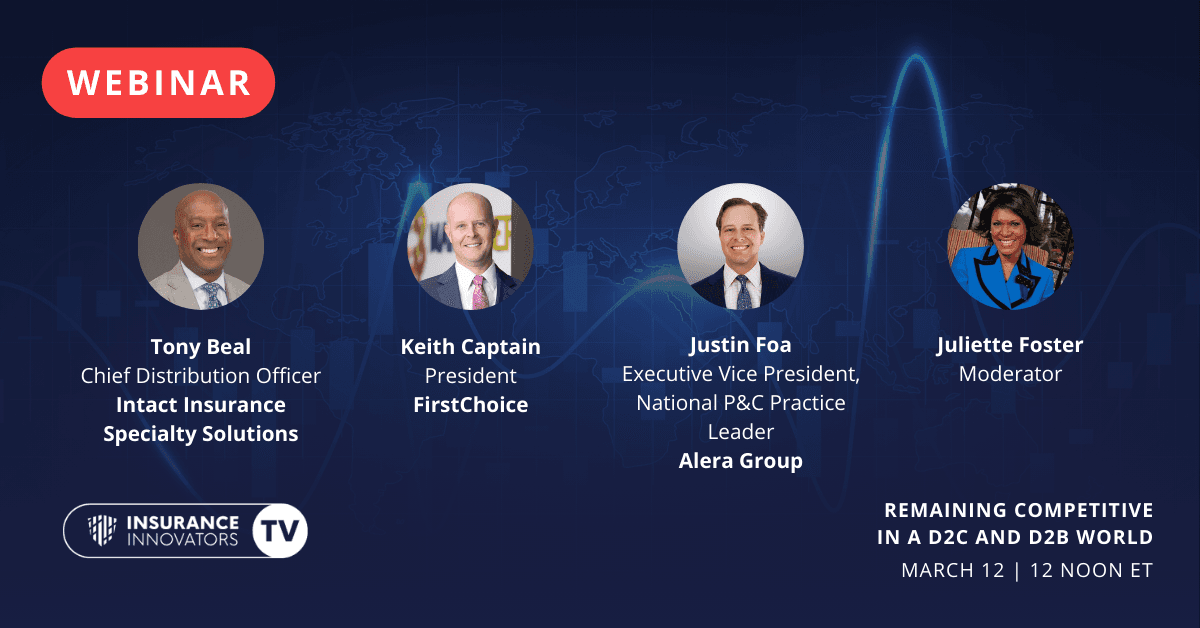
The US insurance distribution landscape is undergoing one of the most significant periods of change in decades. Digital first buying expectations, shifting underwriting appetites, capital constraints, private equity consolidation, and the rise of embedded insurance are reshaping how carriers, brokers, and agents compete for relevance and customer ownership. In this Insurance Innovators webinar, moderated by Juliette Foster, industry leaders from FirstChoice, Alera Group, and Intact Specialty Solutions explored the forces redefining distribution — and what it will take to stay competitive in a market where both direct to consumer (D2C) and direct to business (D2B) models are accelerating.
1. The New Distribution Reality: Disruption, Appetite, and Channel Dynamics
The discussion opened with a clear consensus: US insurance distribution is being reshaped by structural forces, not temporary market cycles. Among the most disruptive trends:
- Digital first expectations across both personal and commercial lines
- Underwriting capacity constraints, especially in property and casualty
- The rise of E&S and wholesalers, now central to market access
- Carrier investment in automation and direct digital channels
- Private equity consolidation, altering broker economics and scale dynamics
- Data becoming a strategic asset, not just an operational input
A key question was whether these shifts signal disintermediation. The panel’s view: intermediaries are not disappearing — but their role is being redefined.
Independent agents: evolving, not eroding
Keith Captain highlighted that independent agents are adapting in diverse ways. Some are doubling down on advisory depth; others are investing in digital tools to compete with national brokers. The common thread is the need to demonstrate differentiated value in a market where clients expect both expertise and convenience.
National brokers: advisory still matters
Justin Foa noted that while clients increasingly expect digital ease, complex risk still demands human advisory. The shift is not away from brokers, but toward brokers who can integrate technology into a consultative model.
Carriers: direct channels are growing, but not replacing intermediaries
Tony Beal emphasised that despite heavy investment in digital distribution, the majority of business still flows through agents and brokers, especially in commercial lines. The intermediary remains indispensable where risk complexity is high.
E&S and wholesalers: now a permanent fixture
The growth of E&S has fundamentally altered distribution. Capacity shortages and risk volatility have pushed more business into non admitted markets, making wholesalers a structural — not temporary — part of the ecosystem.
The overarching theme: we are entering a period of channel convergence, not conflict. Digital, direct, and intermediary models are blending rather than competing in isolation.
2. Scale, Leverage, and Efficiency: The Economics of Modern Distribution
The second section examined how consolidation, capital, and technology are reshaping competitive advantage.
Scale vs. underwriting appetite
Justin argued that while scale can improve negotiating leverage, underwriting appetite still dominates. In a constrained market, even the largest brokers cannot overcome capacity shortages.
Independent agencies: competing without scale
Keith acknowledged that scale is becoming increasingly important — but networks, alliances, and shared services can help independents remain competitive. The question is whether independents can maintain influence or risk being squeezed between national brokers, wholesalers, and direct models.
Is the US overdistributed?
The panel debated whether the market has too many intermediaries chasing the same premium. While fragmentation persists, the group agreed that value, not volume, will determine survival.
Compensation models under pressure
Traditional commission and contingent compensation structures may face reinvention as transparency expectations rise and digital channels alter cost structures.
AI, automation, and data: real impact vs. hype
AI is improving quoting, triage, and submission quality, but the industry is still early in its experimentation. The biggest gains today are in:
- Workflow automation
- Predictive analytics for appetite matching
- Enhanced customer engagement
- Reducing friction in the placement process
The message: AI is augmenting distribution, not replacing it — yet.
3. The Future Model: What US Distribution Will Look Like by 2030
The final section looked ahead to the next five years — a period the panel agreed will be transformative.
What will change
- Greater digital enablement across all channels
- More embedded insurance, especially in small commercial and personal lines
- Increased use of data for risk selection and customer insight
- More hybrid distribution models, blending direct, agent, and platform based approaches
- A shift toward advisory plus technology roles
What will not change
- The need for expert human guidance in complex risk
- The importance of trusted relationships
- The centrality of distribution partners to carrier growth
The broker of 2030
Justin described a future broker who is part consultant, part technologist, and part capital allocator — someone who can interpret data, advise clients, and navigate increasingly complex market structures.
Independent agencies: the path to indispensability
Keith outlined the characteristics of a high performing agency in 2026:
- Strong digital capabilities
- Deep specialisation
- Data driven client engagement
- Operational efficiency
- The ability to demonstrate clear, differentiated value
Carriers: what defines preferred partners
Tony emphasised that carriers will prioritise distribution partners who can:
- Deliver high quality submissions
- Use data effectively
- Invest in digital integration
- Demonstrate operational discipline
- Align with carrier appetite and strategy
The talent pipeline emerged as a major long term risk. The traditional producer model is under strain, and attracting the next generation of distribution talent will be critical.
4. The Strategic Arc: What This Webinar Revealed About the Future of Distribution
Across the discussion, several themes stood out:
- Distribution is not being disintermediated — it is being rearchitected.
- Technology is raising expectations, not replacing expertise.
- Embedded insurance and digital ecosystems will reshape customer ownership.
- The winners will be those who blend advisory depth with digital fluency.
The US market is not moving toward a single dominant model. Instead, it is evolving into a multichannel, multi capability ecosystem where carriers, brokers, agents, MGAs, wholesalers, and platforms all play interdependent roles.